How to Choose a Mattress (UK Decision Guide)
Published 2026-08-03. Last updated 2026-09-23. Desk research by Kaiser Khan — we have not product-tested how to choose a mattress. This is not a shop review and not medical advice.
In short
Choose a mattress by picking the build type first, then matching spring tension or foam support to your body weight, then picking top feel for how you sleep. Check UK size in centimetres and bed base fit. Soft, medium and firm labels mean different things in different shops. Split support from top feel before you compare beds.
- Build
- Type first
- UK King
- 150 × 200 cm
- Soft / medium / firm
- Split the words
Pocket, hybrid, foam, latex or open coil — then tension.
Longer than a Double. Narrower than many EU King sizes.
Those labels mix core support and top feel.
About 5 minutes to read
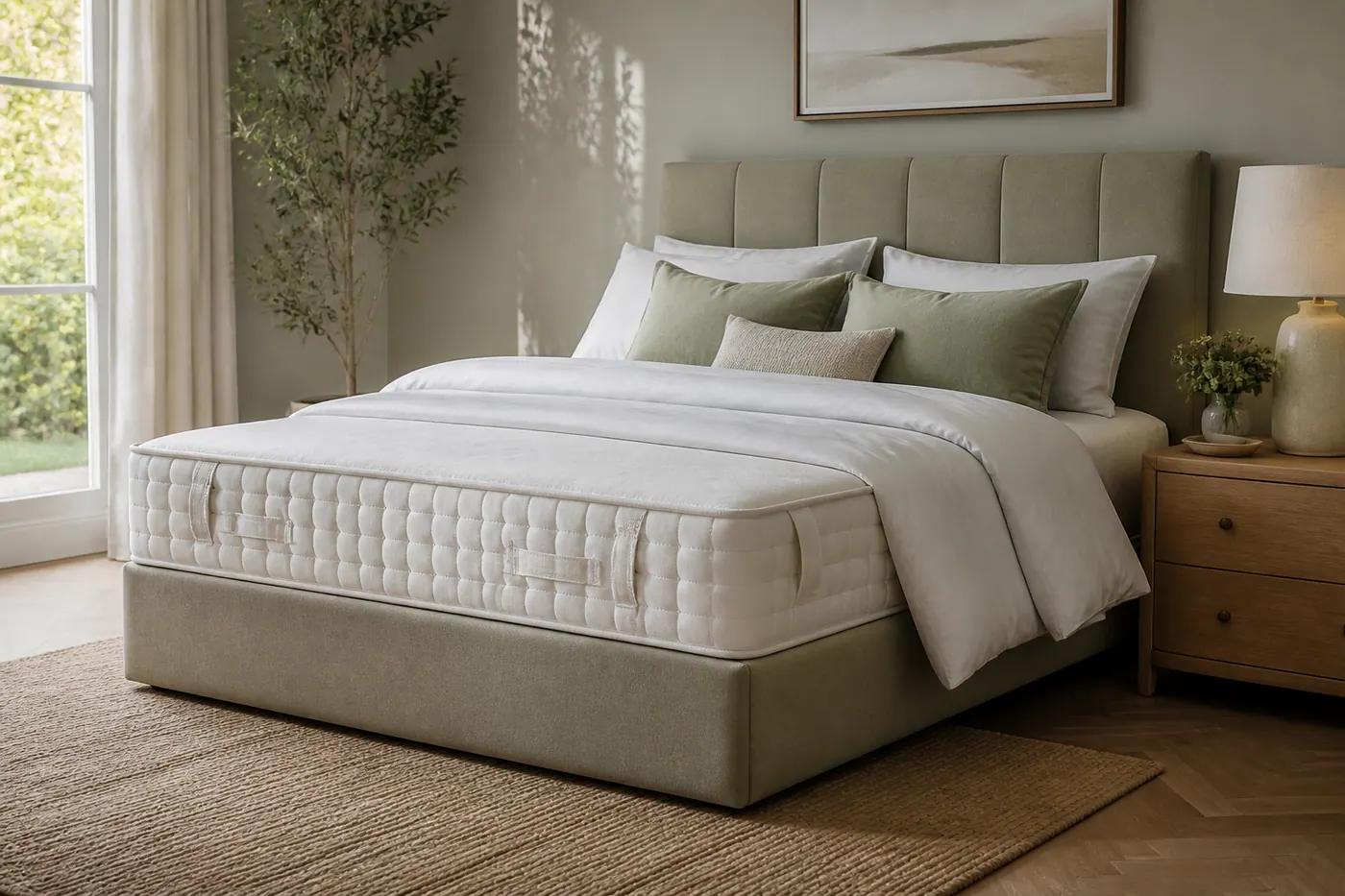
What materials go into this mattress?
Typical builds use pocket springs, open coil springs, memory foam, latex, hybrid stacks. Exact stacks vary by model. Read the spec, not the shop slogan.
- pocket springs
- open coil springs
- memory foam
- latex
- hybrid stacks
What should I decide first when I choose a mattress?
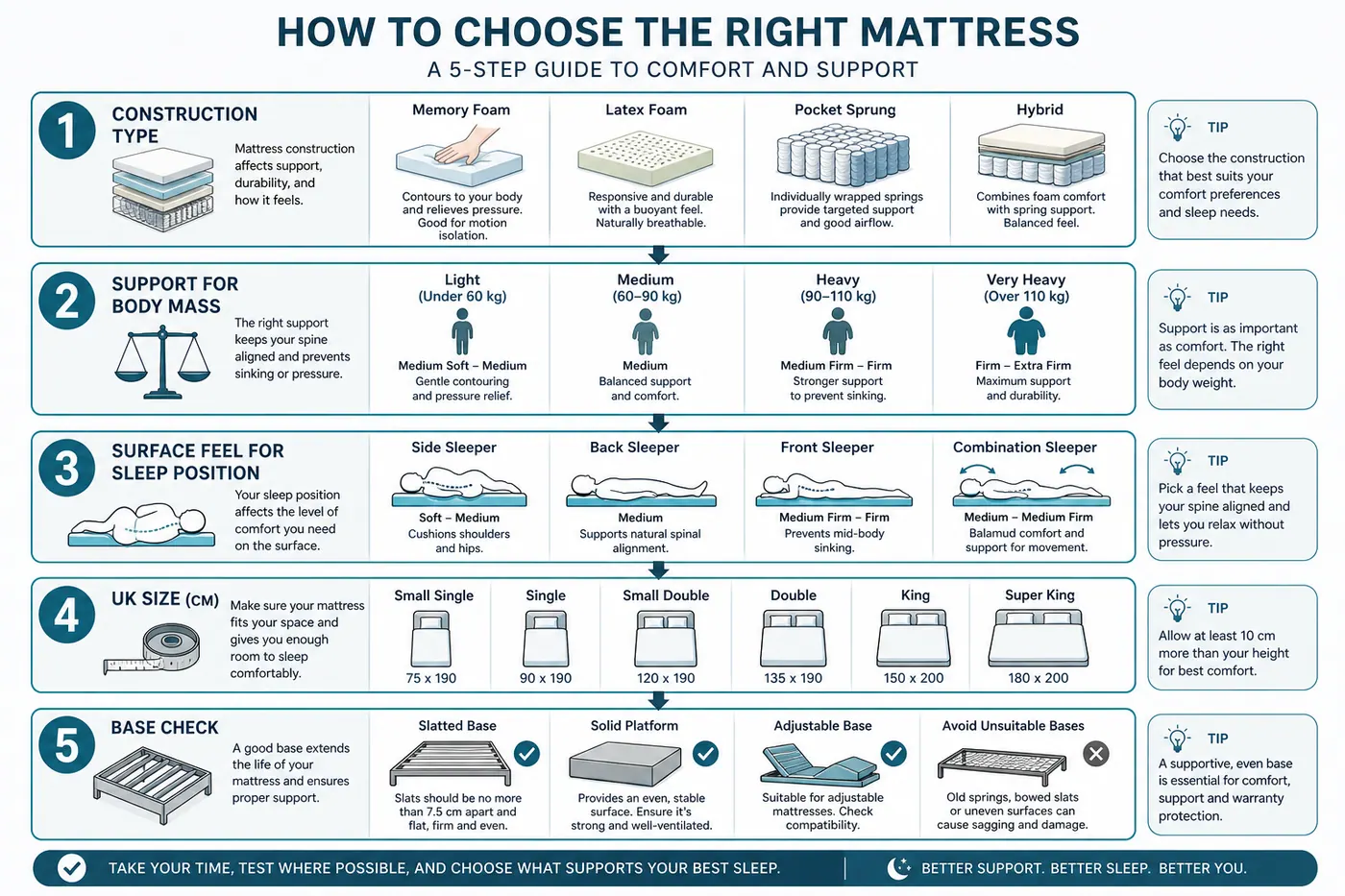
Pick the build type first. Then match support to body weight. Then pick how the top feels for the way you sleep. Then lock UK size in centimetres and check the bed base. Soft, medium and firm labels mix those steps. Split them or you compare unlike things.
This page is a decision order, not a brand list. We have not slept on any mattress here. Use it to ask better questions in a shop or online listing. The full pre-purchase list is before you buy a mattress.
Which mattress type should I start with?
Start with how the core holds you up. Pocket sprung uses steel coils in fabric bags. Open coil links coils into a grid. Memory foam moulds slowly with heat. Latex is bouncier foam. A hybrid is springs plus a thick foam or latex top.
| Type | Good starting point | Skip it if |
|---|---|---|
| Pocket sprung | Springs in fabric bags. Often kinder for couples. Air can move through. | You need a very low profile packed in a box and cannot accept spring feel. |
| Hybrid | Springs plus a thick foam or latex comfort layer | Your base has wide slat gaps the foam maker does not allow. |
| Memory foam | Slow moulding. Can cut partner movement. | You sleep hot and dislike a “hug” feel. |
| Latex | Bouncier foam. Often cooler than classic memory foam. | You want the slow melt of memory foam. |
| Open coil | Linked springs. Usually lower cost. | Partner movement bothers you. |
Overview of all types: mattress types explained.
How do I match support to my body weight?
For pocket sprung and hybrid beds, spring tension (how stiff the springs are) should suit your weight. It is not the same as the word “soft” on the ticket. A heavy sleeper on light tension can bottom out. A light sleeper on heavy tension can feel perched.
For foam beds, read density and ILD as two numbers. Thickness alone is not support. See spring tension vs comfort feel.
We do not publish a kilogram-to-tension chart. Makers use different wires and foams. Ask the maker which tension band they intend for your weight.
How should sleep position change the top feel?
Side sleepers often need more give at shoulders and hips so the spine can stay nearer a straight line from the side. Back sleepers often want a flatter lumbar feel. Stomach sleepers often need less sink so the hips do not drop.
That is surface feel, on top of the support you already picked. Use firmness and sleep position plus the side, back and stomach guides. This is not medical advice.
What size and base must I lock before I pay?
Size first, in centimetres. A UK Double is 135 × 190 cm. A King is 150 × 200 cm. A Super King is 180 × 200 cm. Names are not enough if frames or sheets come from the EU or US. See UK standard sizes.
The base can void a warranty if slat gaps are too wide or the foundation is wrong. Foam-heavy mattresses often need a firm platform or slats with a small gap — makers often quote about 7 cm as a maximum, but the warranty leaflet wins. See base compatibility and how to choose a bed base.
Measure stairs and doors. See footprint and access.
What if two people disagree?
Different body weights or different likes of plushness point to zip-and-link or to a zoned / hybrid build. Motion transfer is a separate question — see motion isolation. A topper will not split two support needs honestly.
What should I ignore in the shop script?
Ignore “orthopaedic” as a medical claim — see what orthopaedic means here. Ignore spring count without a size. Ignore matching quizzes as proof — they are starting points, see how mattress matching quizzes work. Ignore “best mattress 2026” lists on this site: we do not write them.
Ask construction questions instead: questions to ask in a bed shop.
What should I write down in the shop?
Write the support system. Write tension or density for your weight. Write count in this UK size if the bed is sprung. Write width × length in centimetres. Write the approved base. Write trial start and warranty impression depth.
The National Bed Federation says UK size names are industry practice, not a legal Act. IKEA UK lists extra centimetre lines beside standard UK sizes. Both notes were checked on 28 August 2026. A “King” on two tickets can still be two plans.
Take questions to ask in a bed shop with you. The longer checklist is before you buy a mattress.
What happens after I buy?
Plan trial small print, warranty small print and legal refund rights before delivery day. A rolled mattress needs expansion time — rolled mattress expansion. Then break-in and rotate or turn.
Pillow, duvet TOG and a protector change the night as much as the core. Start with how to choose a pillow and how to choose a duvet.
Related BedGuide entries
How it works
Frequently asked questions
What is the first thing to decide when buying a mattress?
Pick the support type first — pocket sprung, open coil, foam, latex or hybrid. Then match spring tension or foam density to your body weight. Then pick how soft or firm the top feels for your sleep position.
Soft, medium or firm — which should I buy?
Those words mix spring support and top feel. For pocket sprung beds, spring tension should suit your weight. The padding on top decides plushness. See our spring tension versus comfort feel guide for the split.
What size mattress do couples need in the UK?
Many couples prefer King (150 × 200 cm) or Super King (180 × 200 cm) over Double (135 × 190 cm) for more width. Always check sizes in centimetres, not just the name on the label.
Can a topper fix the wrong mattress?
A topper can change surface feel a little. It cannot add real spring support or fix a hammocked core. If the mattress is the wrong type or the wrong tension, replace the mattress, not the topper.
What should I ignore in a mattress advert?
Ignore “orthopaedic” as a medical claim, a spring count with no UK size, and matching quizzes sold as proof. Ask for the support system, tension or density for your weight, centimetres, and the approved base instead.
Where do these facts come from?
BedGuide is desk research. The numbers and rules on this page were checked against the official or primary sources below. We name the check date. We do not invent a figure when a source is missing.
- National Bed Federation — regulations and standards — Size names are industry practice. Ask for centimetres before you lock a type or a feel. Checked 2026-08-28.
- IKEA UK mattress size guide — Lists UK standard sizes and extra 80 × 200, 90 × 200 and 140 × 200 lines you must not mix by name alone. Checked 2026-08-28.