How to Choose a Bed Base (UK)
Published 2026-08-03. Last updated 2026-09-08. Desk research by Kaiser Khan — we have not product-tested how to choose a bed base. This is not a shop review and not medical advice.
In short
Choose a bed base by storage need, mattress fit, room size and doorway access. Platform-top divans and firm foundations suit most memory foam and hybrid mattresses. Slats need gaps within warranty limits. Ottomans store more but need lid clearance and gas strut ratings. Adjustable bases need flex-rated mattresses. Match the base to the mattress warranty, not looks alone.
- Match the mattress
- Warranty first
- Slat spacing
- Maker’s limit
- Storage type
- Drawers or lid
- Adjustable bases
- Flex-rated only
The leaflet’s base rule beats the bedstead look.
Check the exact mattress model rather than a general gap rule.
Divan drawers for frequent access. Ottoman for bulk.
The mattress must be allowed to bend with the platform.
About 4 minutes to read
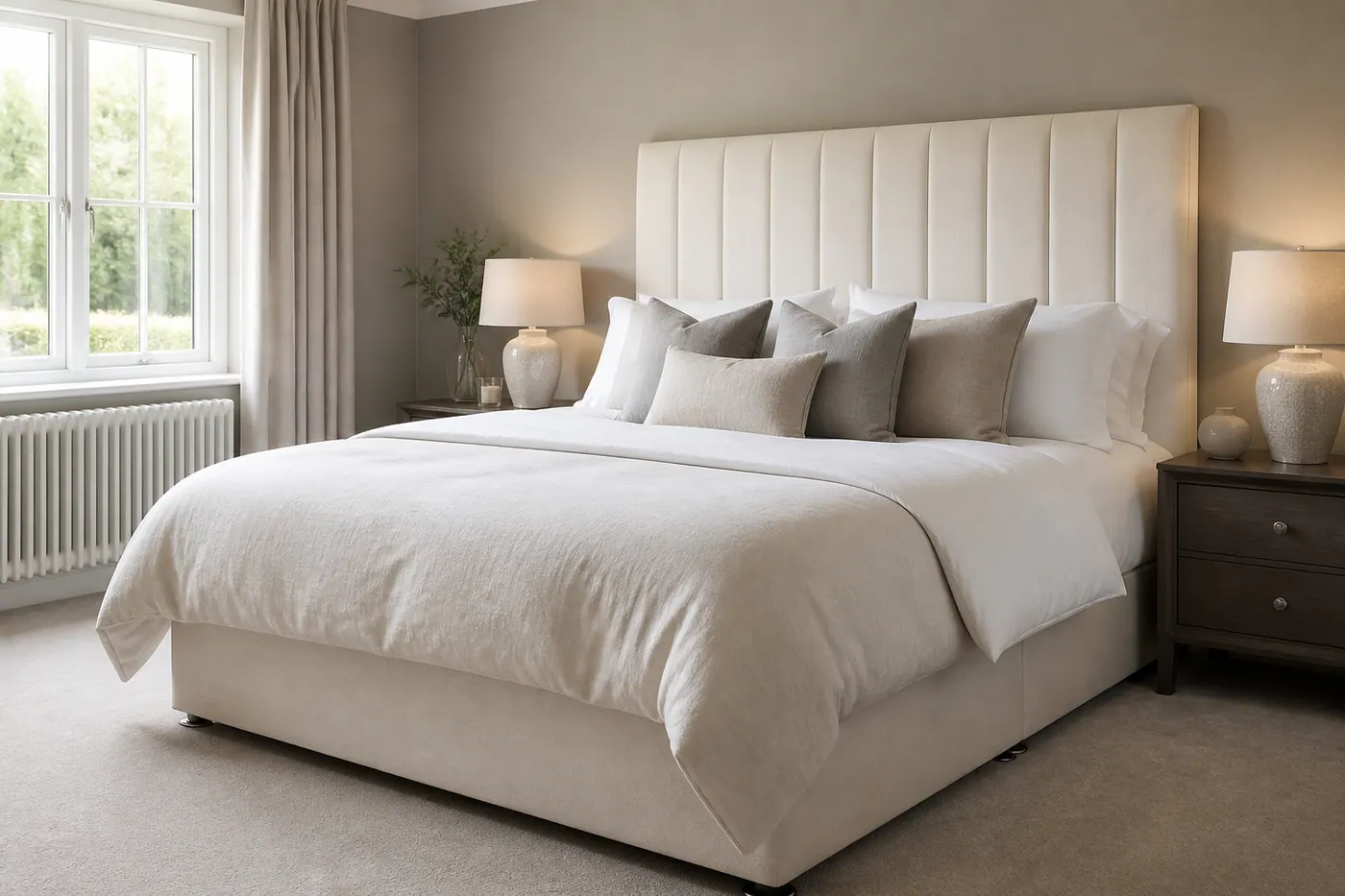
What should I decide first when I choose a bed base?
Try the bed type finder for a starting point, or compare the UK bed types side by side.
Decide storage, mattress fit, room space and doorway access before you fall for a fabric or a curve. The base is the platform the mattress warranty assumes. Looks come last. A pretty sleigh that is too long for the room is still the wrong base.
Work through five questions. Do you need storage? What mattress will sit on it? Slats or a solid top? Do you need to raise the head or foot? What can you actually get up the stairs?
Do I need storage — divan or ottoman?
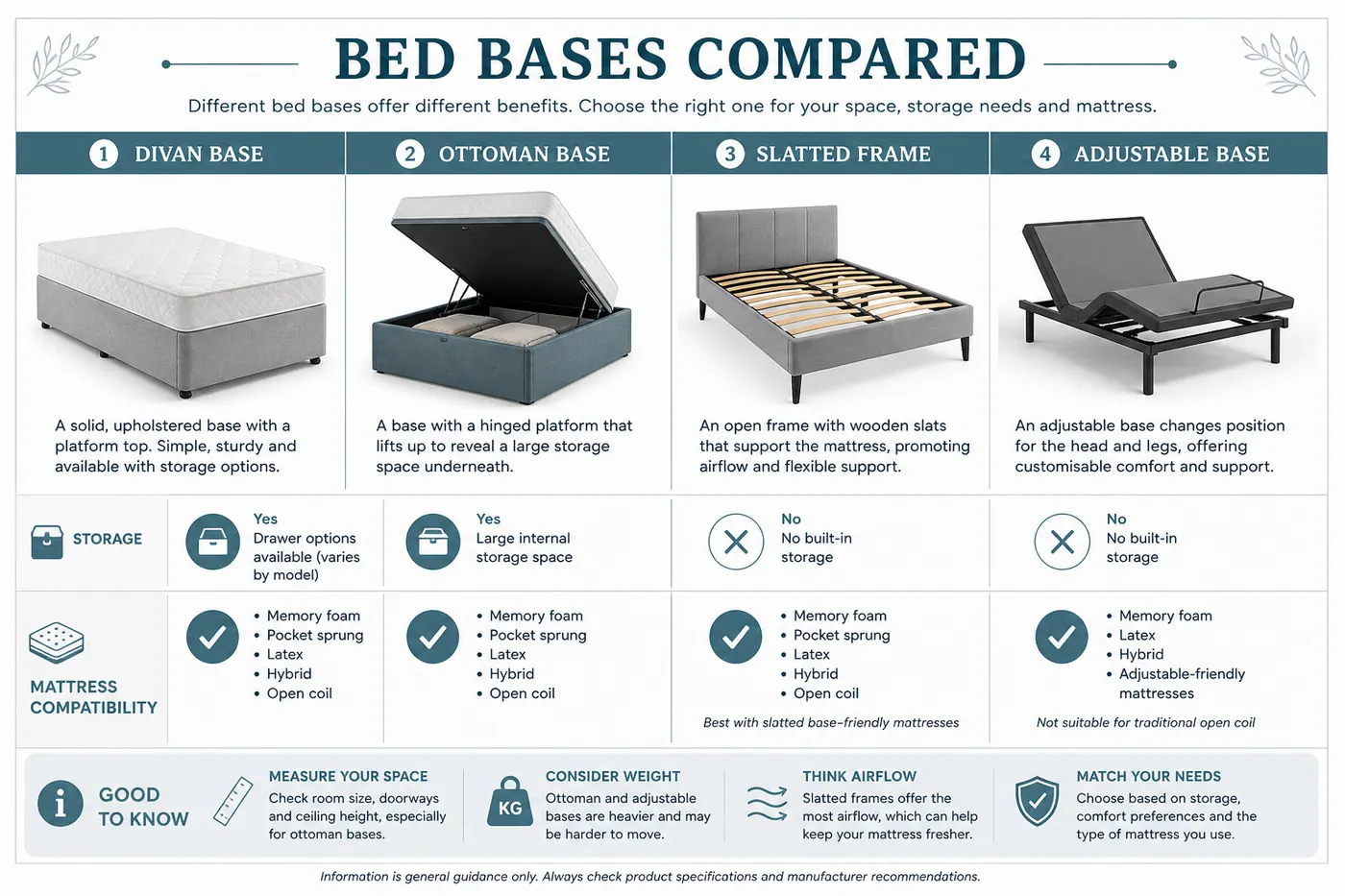
Divan drawers suit things you fetch often: spare bedding, books, off-season clothes in small loads. An ottoman is a big void under a lifting lid. It suits bulky seasonal storage. It needs lid clearance and gas struts rated for the mattress weight.
| Need | Usual base | Skip it if |
|---|---|---|
| Small, frequent access | Divan with drawers | You have no side clearance for drawer travel |
| Large seasonal void | Ottoman | The lid arc hits a window sill or sloped ceiling |
| No storage | Slatted frame, platform or foundation | You later wish you had hidden storage |
Side-lift versus end-lift changes how you stand to open the lid — see side-lift vs end-lift and divan vs ottoman.
What base does my mattress require?
Check the support requirements for your chosen mattress. Unsupported gaps can let parts of a mattress dip. Use the mattress maker’s maximum gap for your model. The base must also meet its other support requirements.
Pocket springs, open coils and foam do not each have one universal base rule. The specific model may allow several base types. Adjustable bases need a mattress the maker explicitly approves to flex.
See mattress–base compatibility. If you have not chosen the mattress yet, read how to choose a mattress first — then come back.
Should I pick slats or a solid top?
A platform top provides a non-sprung support surface. Slats leave openings beneath the mattress. Sprung slats add flex; solid slats are more rigid. Any of these may be suitable when the mattress maker approves the specification.
Measure the clear gap between slats, not the slat width. See solid vs sprung slats and platform-top vs sprung-edge divan.
A sprung-edge divan is a second spring system under the mattress. It can change the feel across the sleeping surface. It is not a medical upgrade.
When does an adjustable base make sense?
When you need to raise the head or feet in bed and the mattress is sold as compatible. Skip it if the mattress is a stiff traditional spring unit that the maker does not rate to bend. You also need wall clearance behind the moving frame. See adjustable beds.
This is a mechanism note, not a prescription.
How do room size and delivery change the choice?
Ottoman lids need an arc. Sleigh scrolls need extra floor length — see sleigh beds. Bunks need ladder and ceiling clearance — see bunks and high sleepers. Guest rooms may want a sofa bed instead of a full divan.
Measure doorways, stairs and the assembled footprint. See bed footprint and access and delivery and disposal. Fabric and colour are cosmetic — upholstery fabrics will not save a base that fails the mattress warranty.
Quick matrix
| Base | Storage options | Main mattress check |
|---|---|---|
| Platform-top divan | Drawers or an ottoman design | Approved support surface |
| Sprung-edge divan | Model dependent | Compatibility with a second spring system |
| Ottoman | Lift-up storage | Support deck and permitted mattress weight range |
| Slatted frame | Some have drawers or a lift | Slat type, gaps and centre support |
| Solid foundation | Model dependent | Required support and ventilation |
| Adjustable | Model dependent | Exact mattress approval for the moving base |
Related BedGuide entries
How it works
Frequently asked questions
What is the best base for a memory foam mattress?
Use a base approved by the mattress maker. Check support type, slat spacing and centre support. Requirements vary, so a general rule about foam cannot confirm a particular pairing.
Divan or ottoman for storage?
Divan drawers suit frequent small access — socks, spare bedding, books. Ottomans suit large seasonal storage if you have lid clearance and gas struts rated for the mattress weight.
Can the wrong base void a mattress warranty?
Yes. Many warranties require a suitable firm base and a maximum slat gap. A hammocked slat deck can be treated as misuse. Read the mattress leaflet, not the bedstead brochure, for that rule.
Where do these facts come from?
BedGuide is desk research. The numbers and rules on this page were checked against the official or primary sources below. We name the check date. We do not invent a figure when a source is missing.
- Bed Advice UK: bed bases explained — Definitions of divans, sprung bases, bedsteads and adjustable bases. Checked 2026-09-08.
- Simba Sleep: suitable mattress bases — An example of a maker specifying a maximum slat gap of 7.5 cm; other makers and models may differ. Checked 2026-09-08.