Mattress Warranty Explained (UK)
Published 2026-08-03. Last updated 2026-08-28. Desk research by Kaiser Khan — we have not product-tested mattress warranty. This is not a shop review and not medical advice.
In short
A mattress warranty is a maker’s promise about manufacturing faults and abnormal sag — not a comfort guarantee. Trials cover “I don’t like the feel.” Warranties often exclude normal body impressions below a stated depth, wrong bases, missing protectors, stains, and misuse. Read the base, rotation and impression rules before you buy. Keep proof of purchase and photos.
- What it covers
- Faults, not feel
- Trial vs warranty
- Shop rule
- Proof
- Keep photos
- Common void
- Wrong base
Soft or firm dislike is usually a trial issue, not a warranty.
A trial is the seller’s comfort clock. A warranty is faults and sag.
Receipt, fire label and sag photos help a later claim.
Wide slat gaps and missing protectors often sit in the small print.
About 4 minutes to read
What is a mattress warranty in the UK?
A mattress warranty is the maker’s written promise about faults and abnormal sag. It is not a comfort guarantee. It is not a shop’s sleep trial. It is not a consumer-law cooling-off period on its own. Those three ideas get mixed in adverts. They are different documents with different clocks.
BedGuide explains the usual pattern. Your PDF and retailer terms win. We have not audited every brand’s small print.
How does a warranty differ from a trial or a return?
A warranty looks for a defect. A trial looks at whether you like the feel. A shop return looks at that shop’s policy and, for distance sales, consumer-law cooling-off. Mixing them is the most common buying mistake.
| Promise | What it is for | Typical limit |
|---|---|---|
| Warranty | Faults and abnormal structural sag | Years; excludes comfort dislike |
| Trial | Changing your mind about feel | Days or nights; unused or lightly used rules |
| Retail returns | Shop policy or consumer law | Varies; not the same as warranty |
If you dislike firmness after a week, that is usually a trial question. If a spring has broken, that is usually a warranty question. If the parcel is unopened after a home delivery, that may be a returns question. Legal refund clocks sit on UK bed refund and return rights. Ask which document you are using before you book a collection.
What do mattress warranties usually cover?
Most UK mattress warranties talk about manufacturing faults and sag deeper than a stated depth after a break-in wait. Faults can include a failed seam, a broken handle, or a spring that has given way where the text lists that part. Sag is measured as a dip, often with a straight edge, on a flat floor, with nobody lying on the bed.
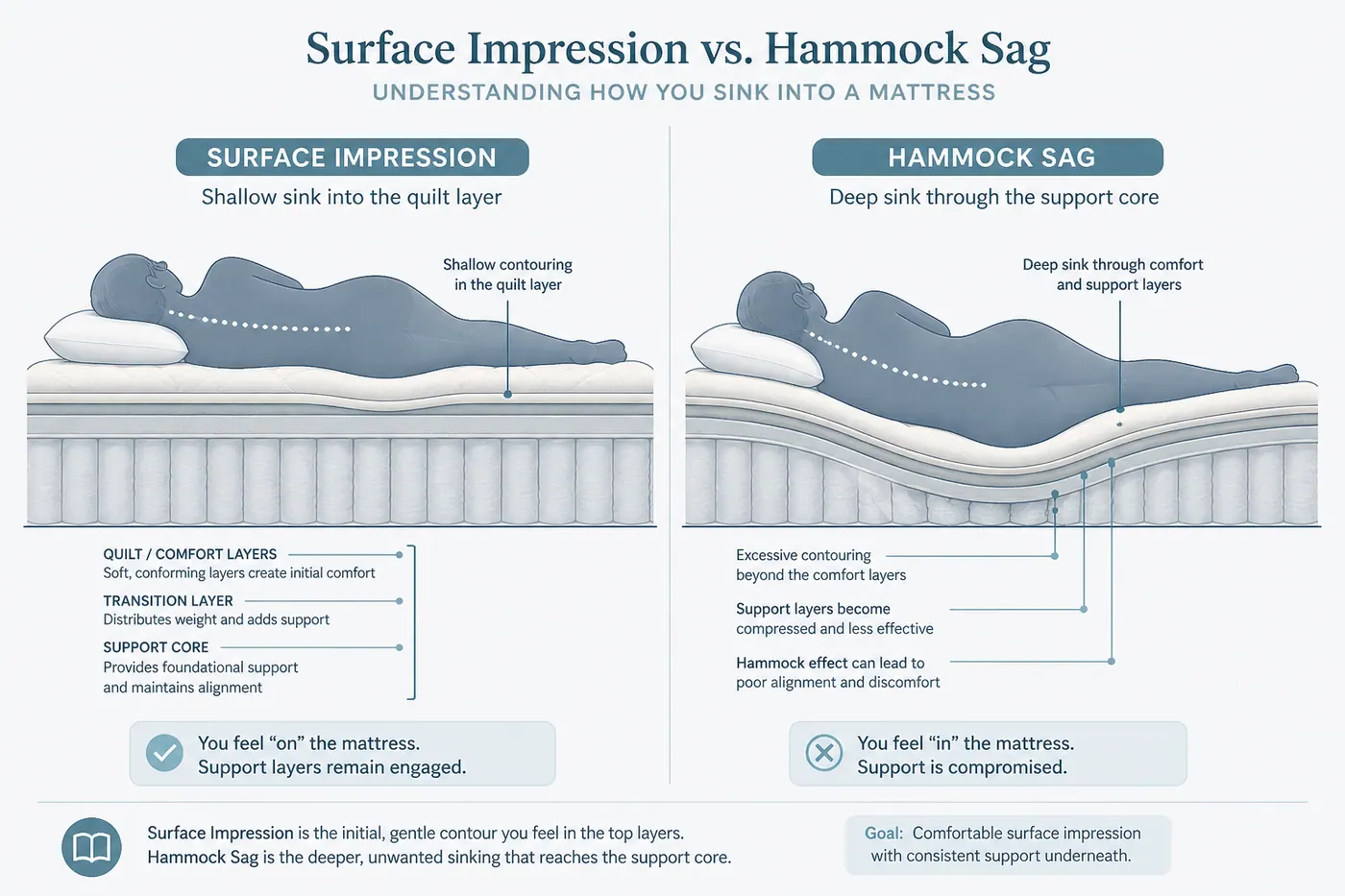
They usually do not cover “it feels too soft now.” Comfort layers settle. A shallow body impression is often treated as normal. See body impressions and sag. The depth number in the warranty is the line, not a shop slogan.
Cover is also not a lifespan promise. A ten-year warranty does not mean the mattress will feel new in year nine. It means the maker will look at listed faults during that window if you kept the rules.
What usually sits outside the warranty?
- Soft, medium or firm preference after sleep.
- Normal body impressions under the written depth.
- A base or slat gap the maker forbids.
- Stains, liquids, pet damage, smoking burns, cuts or jumping.
- A missing protector when the warranty requires one.
- Guest-house or other commercial use on a domestic warranty.
- A law label cut off when the text says keep it on.
None of those lines is universal. They are the pattern. Read your document.
How do I keep a mattress warranty valid?
Use a suitable base: a platform, a platform-top divan, or slats within the gap rule (often about 7 cm clear). Fit a washable protector if required. Rotate on the schedule given. Turn the mattress only if it is double-sided. Keep the fire label attached.
Keep the receipt. Photograph the setup and any dip with a ruler in the shot. Claims without proof of purchase or proof of the base are the ones that stall.
How is sag usually measured?
Makers often ask you to put the mattress on a flat floor. They do not want a photo of a dip while you are lying on a slatted bed. They want an unloaded dip against a straight edge. A body impression you can see in the evening can look smaller in the morning. Wait, then measure as the leaflet says.
If the dip is under the limit, that is usually not a claim. If it is over the limit and the base was legal, that is the conversation. BedGuide will not invent a millimetre figure that every brand shares. Brands write their own depths.
Who should use this page, and who should skip it?
Use this page if you are comparing a trial with a warranty before you buy, or if you are checking whether a dip might be a claim. Skip it if you need a lawyer, a named SKU certificate, or a “best warranty brand” list. We will not write those.
Related BedGuide entries
How it works
Frequently asked questions
Does a mattress warranty cover feeling too soft or too firm?
Usually no. Comfort preference is what a sleep trial (if offered) is for. Warranties focus on faults and sag beyond a written depth, not “I changed my mind about firmness.”
What commonly voids a mattress warranty?
Typical exclusions include an unsupported base or oversize slat gaps, missing waterproof protector where required, stains, burns, cuts, jumping on the bed, and commercial use when the warranty is for home use. Always read your specific document.
Is a body impression the same as sag?
No. A shallow body impression is often treated as normal softening. Sag that exceeds the warranty’s depth limit (measured unloaded on a flat surface) may be a claim. See body impressions and sag.
Do I need to keep the fire label on for the warranty?
Many UK warranties ask you to keep the law label attached. That label is also how trading standards check fire rules. Cutting it off to “tidy the bed” can make a later claim harder. See UK mattress fire regulations.