Talalay vs Dunlop Latex Manufacturing
Published 2026-08-03. Last updated 2026-08-03. Desk research by Kaiser Khan — we have not product-tested Talalay versus Dunlop latex. This is not a shop review and not medical advice.
In short
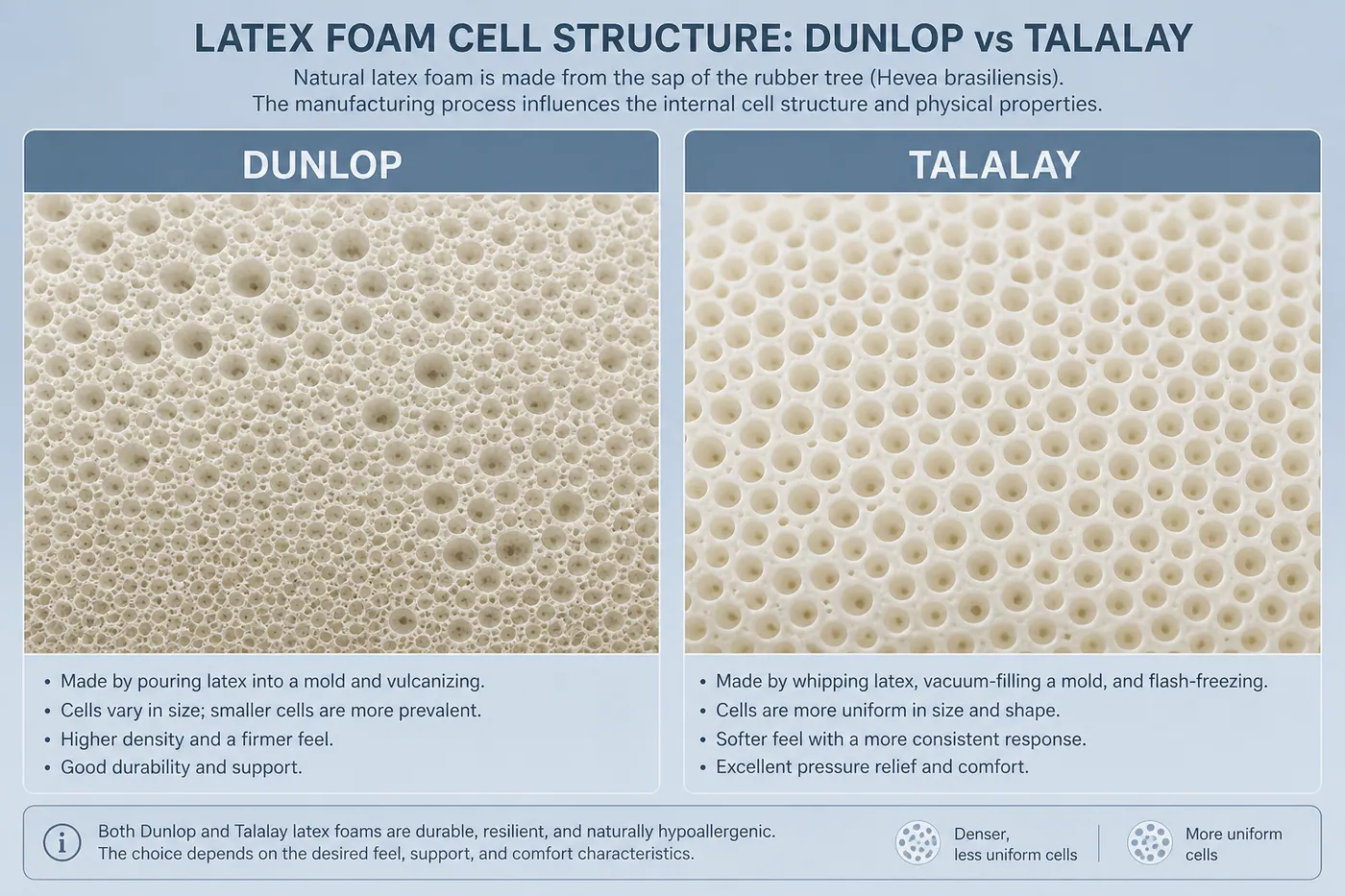
Dunlop and Talalay are two ways to turn liquid latex into foam. Dunlop latex is poured into a mould and heated. It usually feels denser. Talalay latex is expanded with vacuum, frozen, then heated. It has more even air pockets. Either process can use natural latex, synthetic latex, or a mix. The process name does not tell you the source.
About 1 minutes to read

What materials go into this mattress?
Typical builds use natural latex (Hevea brasiliensis) or synthetic latex, vulcanising agents, mattress cover textiles. Exact stacks vary by model. Read the spec, not the shop slogan.
- natural latex (Hevea brasiliensis) or synthetic latex
- vulcanising agents
- mattress cover textiles
How long does this mattress typically last?
A typical range is 8– 12 years. Body weight, base support and rotation change that. It is not a warranty promise.
8– 12 years
Three things to check separately
When reading a latex mattress, keep these apart:
- Process — Dunlop or Talalay (how the foam was made).
- Source — natural, synthetic, or a blend percentage.
- Hardness — ILD of the layer.
Mixing any two up leads to wrong expectations.
Process comparison
| Step | Dunlop | Talalay |
|---|---|---|
| Frothing | Yes | Yes |
| Mould fill | Poured | Vacuum-expanded |
| Cell set | Heat vulcanise | Freeze, then vulcanise |
| Typical feel tendency | Denser, more progressive | More uniform / buoyant |
Where latex sits in a bed
Latex usually bounces back faster than memory foam and often sleeps cooler than classic memory foam — still pair with heat and cooling bedding rules.
Allergy note
Natural latex proteins can be an issue for some people. Synthetic latex is a different material. See hypoallergenic materials.
Related BedGuide entries
How it works
Frequently asked questions
Is Talalay latex always natural latex?
No. Talalay and Dunlop name the making process, not where the latex came from. Either process can use natural latex, synthetic latex, or a blend. Read the label for natural content percentages separately.
Why does Dunlop latex often feel denser than Talalay latex?
Dunlop processing usually makes a denser foam with a steady compression feel. Talalay vacuum expansion and freezing create more even air pockets. Many sleepers find Talalay bouncier and more uniform through the layer.
Is natural latex the same as organic latex?
No. Natural means it came from rubber-tree latex. Organic refers to certified farming and processing when claimed. Synthetic latex is made from petroleum. Read feedstock percentages separately from process names.