UK Mattress Fire Safety Labelling (BS 7177)
Published 2026-08-03. Last updated 2026-09-23. Desk research by Kaiser Khan — we have not product-tested UK mattress fire regulations BS 7177. This is not a shop review and not medical advice.
In short
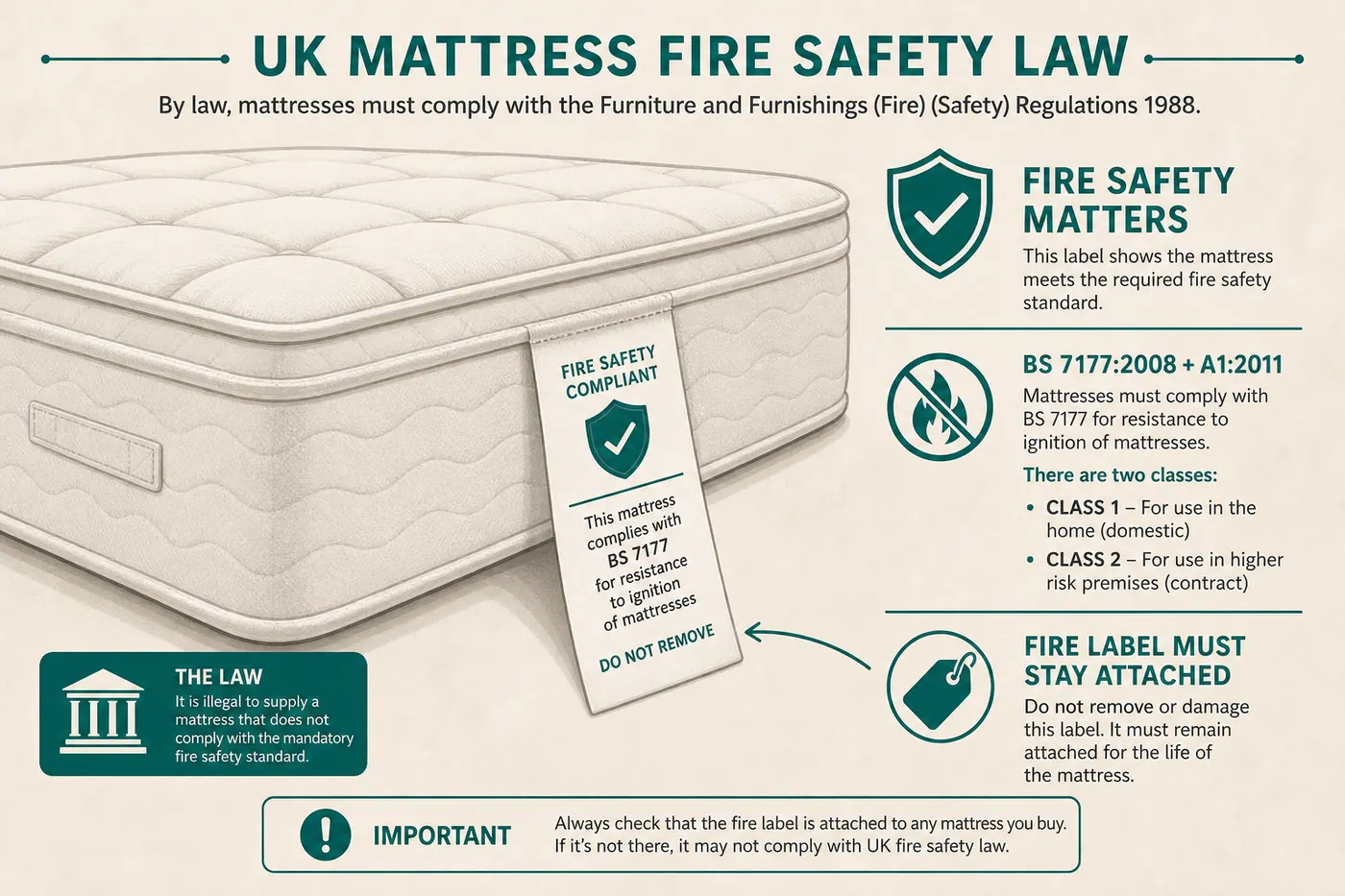
BS 7177 is the UK standard used to test the ignition resistance of mattresses, mattress pads, divans and bed bases. It does not make a product fireproof. A 2025 rule change removed the legal requirement for a furniture display swing label and excluded some small children’s mattresses from the 1988 regulations. Check the permanent product information and current maker guidance.
- Common mattress standard
- BS 7177
- Permanent label
- Keep it on
- Display labels
- 2025 change
- What a pass means
- Not fireproof
Resistance to ignition of mattresses, pads, divans and bed bases.
Keep product information attached for later identification.
A furniture swing label is no longer required by the amended rules.
Tests set ignition resistance. They do not stop a fully developed fire.
About 5 minutes to read
Why do UK mattresses carry fire labels?
UK furniture fire-safety rules aim to limit how easily soft furnishings ignite from common sources such as a smouldering cigarette or a match-sized flame, under set tests. Mattresses, many mattress pads and divans sit in that framework. The label is how the tested product is named on the bed.
The domestic furniture rules include the Furniture and Furnishings (Fire) (Safety) Regulations 1988, as amended. The official 2025 amendment guidance explains recent changes. Read both the law and its current guidance if you need to check a business obligation.
BS 7177 is the British Standard commonly used for resistance to ignition of mattresses, mattress pads, divans and bed bases. Editions update. For a legal decision, read the current official text. This page is education. It is not legal advice.
What is BS 7177, in plain words?
BS 7177 groups products by how they are meant to be used. It sets ignition-resistance performance for that group. A domestic mattress is not tested as if it were a high-hazard contract product. The label should show the standard and the grade that matches the intended environment.
BSI’s public listing for BS 7177:2008+A1:2011 specifies resistance to ignition under named test methods. It also says those levels do not necessarily show how the product behaves in a fully developed fire.
You cannot see the test from the ticking colour. You read the label.
Does a fire label mean the mattress will not burn?
No. The tests set performance against defined ignition sources under lab conditions. They do not make a mattress fireproof. Keep smoking materials, heaters and damaged flexes away from bedding. An electric blanket has its own instructions.
A missing or cut-off permanent product label can make it harder to identify what was supplied. It does not mean the foam is “more natural”. Ask the seller for the product paperwork if the information is unclear.
In short: a pass is not a magic shield. It is a test result for a named use.
What changed to UK fire-safety labels in 2025?
From 30 October 2025, the amended 1988 furniture regulations no longer require a display label (often called a swing label) on new products. The government says permanent-label obligations for furniture under those regulations remain. A retailer may still use a swing label. Its absence alone does not prove a product is unsafe or non-compliant.
The same amendment excludes certain baby and children’s mattresses from the 1988 rules when both their length is under 170 cm and their width is under 75 cm. They must still meet applicable general product safety rules. This is a narrow size-based change, not a blanket exemption for all children’s beds. See the government guidance for the detailed scope.
What should I look for on a mattress label?
Look for permanent product information and any extra tag that names the standard and intended use. Domestic wording is not the same as a hotel or hospital grade. Ask the maker which standard applies to that specific mattress.
Keep any sewn-in label attached and save the paperwork. Cutting it off can also cause warranty trouble. A swing tag is optional under the amended furniture rules; do not rely on one as the only evidence.
If you buy second-hand, a missing label is a reason to be careful. See second-hand mattress hygiene. Hygiene and fire documentation are different issues. Both matter.
Do toppers and protectors need their own marks?
Often the extra layer needs its own paperwork. Do not assume the mattress label covers every layer you add later. A thick topper or an unmarked cover can change how the sleep system behaves.
BSI’s listing says BS 7177 does not apply to mattress protectors. Pads and toppers can still sit under other fire rules. The UK furniture regulations can still apply to fillings. Read the label on that extra layer. When in doubt, keep the maker’s current specification, not a forum post.
What else can break the labelled setup?
Removing the label. Replacing the cover with an unmarked one. Damaging the ticking. Using the mattress on a base the maker forbids can be a warranty issue as well as a support issue.
Fire labels sit beside other marks such as OEKO-TEX and certifications explained. Those logos have narrow scopes. They are not a second fire test unless the paperwork says so.
Domestic grades are not the same as contract or high-hazard grades. A hotel or hospital specification can demand a tougher band. Do not copy a domestic label onto a contract purchase.
Who should use this page, and who should skip it?
Use this page if you are reading a UK mattress hang-tag and you want the fire line in plain words. Skip it if you need a solicitor. Skip it if you need a test certificate for a named SKU. Skip it if you want a “safest brand” table. We will not invent those.
Related BedGuide entries
How it works
Frequently asked questions
What is BS 7177 on a mattress?
BS 7177 is the British Standard commonly used for resistance to ignition of mattresses, mattress pads, and divans. Products carry labels showing the grade appropriate to their intended environment.
Does a fire label mean the mattress will not burn?
No. Flammability standards set ignition-resistance performance under test conditions. They do not make a mattress fireproof. Keep heat sources and smoking materials away from bedding.
Do toppers and protectors need fire labels too?
Many mattress pads and some covers sold for UK domestic use also fall under flammability rules. Check the product’s own labelling rather than assuming the mattress label covers every layer added later.
Can I cut the fire label off?
Keep any permanent product label attached so you can identify its maker, model and stated standard later. A separate display swing label is no longer required by the amended furniture regulations. Save the product paperwork and ask the maker if a label is missing or unclear.
Does BS 7177 apply to mattress protectors?
The BSI listing for BS 7177 says the standard does not apply to mattress protectors. Pads and toppers can still sit under other fire rules. Read the label on that extra layer. This is not legal advice.
Does a UK mattress still need a fire safety swing label?
The October 2025 amendment removed the display or swing-label requirement from the 1988 furniture regulations. Permanent-label duties for products within those rules remain. A missing swing label alone does not prove a mattress is unsafe. Check the permanent information and ask the maker.
Are children's mattresses exempt from UK fire safety rules?
Some mattresses intended for babies or children are outside the 1988 furniture regulations if they are under 170 cm long and under 75 cm wide. They still have to meet applicable general product safety rules. Larger children's mattresses are not covered by that size-based exclusion.
Where do these facts come from?
BedGuide is desk research. The numbers and rules on this page were checked against the official or primary sources below. We name the check date. We do not invent a figure when a source is missing.
- Furniture and Furnishings (Fire) (Safety) Regulations 1988 — Official UK regulations text for furniture and furnishings fire safety, including fillings that mattress builds often rely on. Checked 2026-08-28.
- BSI Knowledge — BS 7177:2008+A1:2011 — Official standard listing. Covers mattresses, pads, divans and bed bases. BSI states it does not apply to mattress protectors. Checked 2026-08-28.
- UK Office for Product Safety and Standards — 2025 fire safety amendment — Statutory guidance for the October 2025 change. Explains removal of display labels, continued permanent-label rules, and the size-based exclusion for certain children’s mattresses under the 1988 regulations. Checked 2026-09-23.