Questions to Ask in a Bed Shop (UK)
Published 2026-08-03. Last updated 2026-08-28. Desk research by Kaiser Khan — we have not product-tested questions to ask when buying a mattress. This is not a shop review and not medical advice.
In short
In a UK bed shop, ask what the support system is, which spring tension or foam density suits your weight, how soft or firm the top feels, and what base the warranty needs. Then ask trial rules, body-impression limits, turnability and delivery or old-mattress options. Soft, medium and firm alone are not enough.
- Support system
- Mechanism first
- Size
- Ask the centimetres
- Two tracks
- Trial ≠ warranty
Pocket, open coil, foam, latex or hybrid — before “medium”.
Names are not a world standard. Write width × length.
Comfort dislike is usually a trial issue, not a fault claim.
About 6 minutes to read
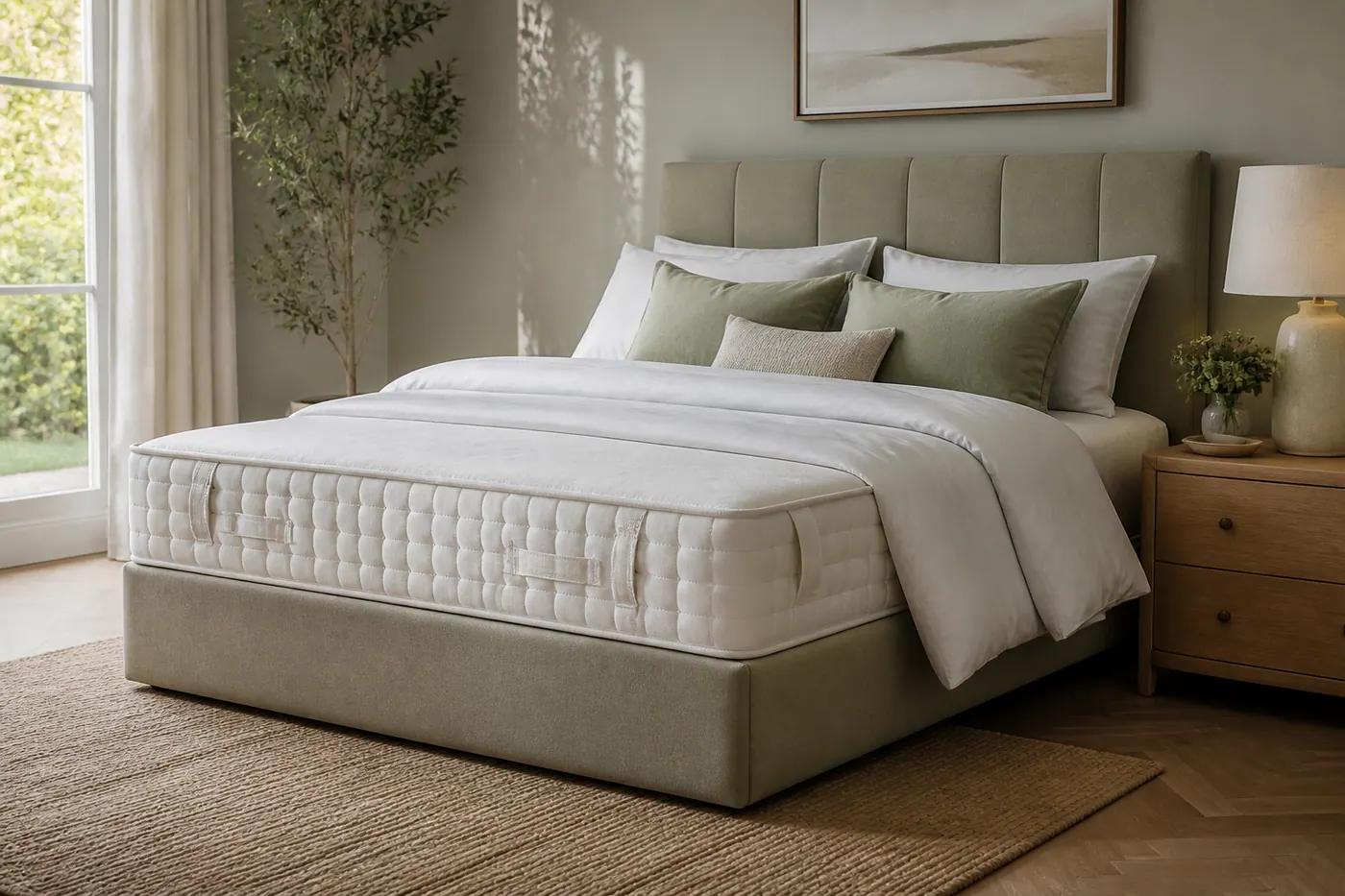
What materials go into this mattress?
Typical builds use pocket springs, open coil springs, memory foam, latex, hybrid stacks. Exact stacks vary by model. Read the spec, not the shop slogan.
- pocket springs
- open coil springs
- memory foam
- latex
- hybrid stacks
How long does this mattress typically last?
A typical range is 6– 10 years. Body weight, base support and rotation change that. It is not a warranty promise.
6– 10 years
What is the most useful question in a UK bed shop?
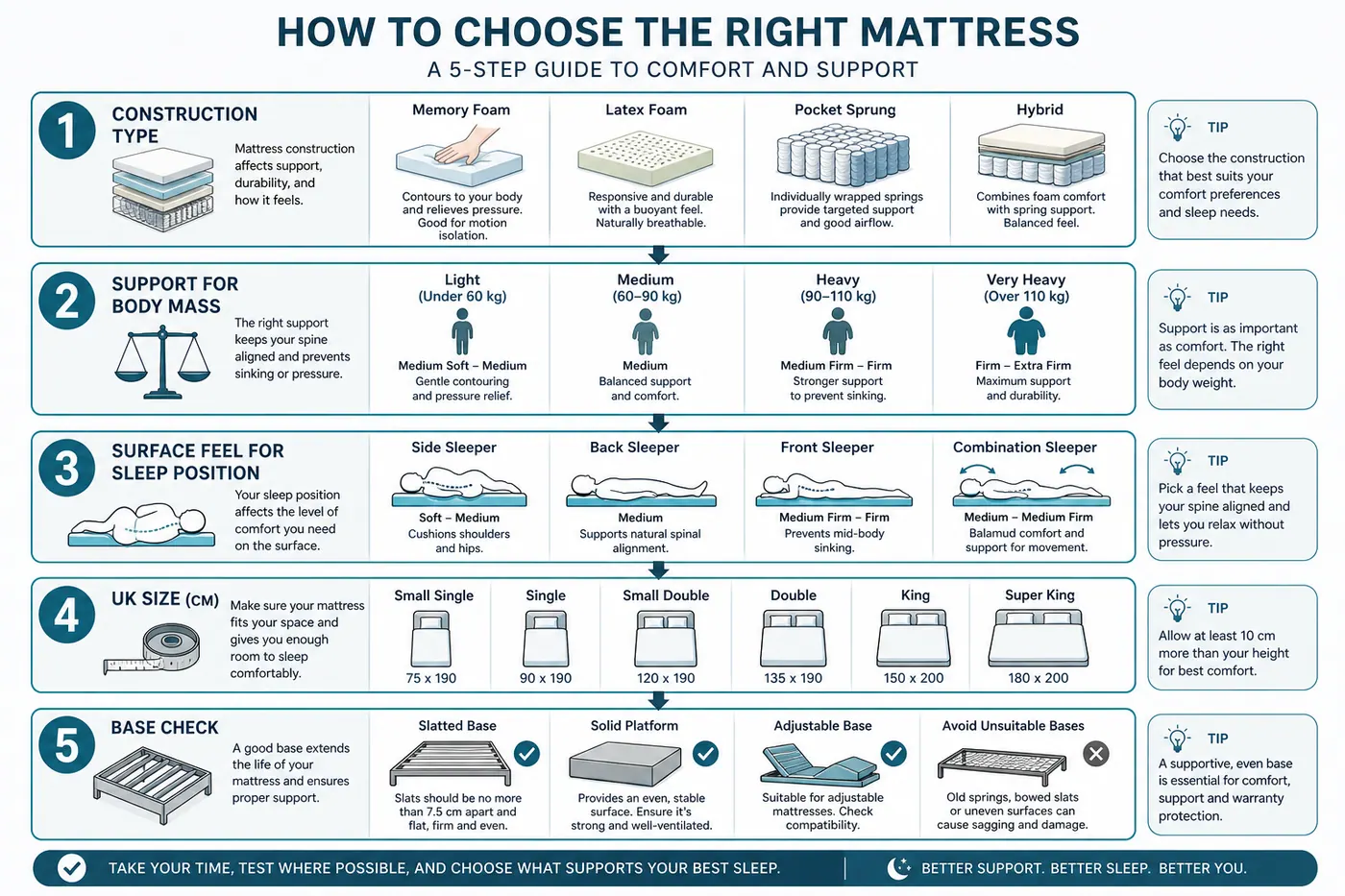
Ask what the support system is. Pocket sprung, open coil, foam, latex or hybrid. Then ask which spring tension or foam density is aimed at your body weight. Soft, medium and firm alone mix support and top feel. Write the facts down before you compare prices.
This page is a script. It is not a ranking. We have not slept on the beds on the floor. Use it in a showroom or on a product page. The decision order sits on how to choose a mattress. The full pre-purchase list sits on before you buy.
What construction questions should I ask?
Start with the core. Then the comfort stack. Then the edge. Then whether you can turn the bed.
- What is the support system? Pocket sprung, open coil / Bonnell, continuous coil (for example Miracoil-style units), foam, latex or hybrid?
- If pocket sprung — how many springs in which UK size? Spring count must be read with size — see spring count explained and how count is marketed.
- Which spring tension is this model? Soft / medium / firm on the ticket may be top feel, not tension — see spring tension vs comfort feel.
- If foam — what density and ILD? Thickness alone is not support. See foam density and ILD.
- What is in the comfort layers? Foam only, wool, cotton, latex, pillow top? See what’s inside and GSM / upholstery depth.
- Is it one-sided or turnable? Turnable builds often age more evenly — see turning vs rotating.
- How is the edge finished? Foam-encased, rod edge, or thin border? See edge support.
If the seller cannot split tension from top feel, you are still in slogan land. Stay there until they can.
What size and base questions should I ask?
Ask for centimetres. A UK Double is 135 × 190 cm. A UK King is 150 × 200 cm. A Super King is 180 × 200 cm. The National Bed Federation says those names are industry practice, not a legal Act. That note was checked on 28 August 2026.
IKEA UK lists standard UK sizes and extra centimetre lines. That guide was checked on the same day. “Sold in the UK” is not the same as “UK King”.
- What UK size is this in centimetres?
- What base is approved for the warranty? Platform, divan, max slat gap?
- Does this suit an adjustable base? Only if the maker says so.
- How does it handle partner movement? Ask for construction reasons, not slogans — see motion isolation.
- What firmness band suits my sleep position and weight? Use firmness and sleep position.
Write the slat gap. Foam-heavy beds often need a small gap. Makers often quote about 7 cm as a maximum. The warranty leaflet still wins.
What trial and warranty questions should I ask?
A trial is a period when you may return the mattress if you dislike it, under the seller’s rules. A warranty covers stated faults such as sag beyond a threshold. Comfort dislike is usually a trial issue. Do not mix the two.
- How long is the trial, and when does it start? Delivery day or after break-in? Fees for collection? See trial periods.
- What does the warranty cover and exclude? Body impression depth; stains; wrong base. See warranty explained and what voids a warranty.
- Can you remove the old mattress? Cost, same day or separate booking? See delivery and disposal.
- Is finance or a discount changing the return rules? Sometimes promotions tighten trial terms. Read the written policy.
- Must the sewn-in fire label stay on? Usually yes. See UK fire labels.
- If I change my mind, is that a shop return, a trial, or the law? In a shop, change of mind is usually shop policy. Online it may be a 14-day cancel right. A fault is a separate legal track. See UK bed refund and return rights.
Ask for the body-impression depth in millimetres. We do not invent a shared number. The maker’s card is the only number that counts for that claim.
Should I trust a matching quiz on the shop tablet?
Treat quizzes as a starting filter. They can miss partner weight differences, base type and trial small print. Cross-check with the construction questions above. See how mattress matching quizzes work.
Ignore “orthopaedic” as a diagnosis. See orthopaedic labels. Ignore a giant spring count with no size. Ignore “best mattress 2026” talk on this site. We do not write those lists.
How should I use the answers?
Write the facts down before you compare prices. Two mattresses with the same “medium” label can differ in tension, fill mass and turnability. That is what budget vs premium is about.
| Write this | Why it matters |
|---|---|
| Support system | You are comparing like with like |
| Tension or density for your weight | Soft on the ticket may be the quilt, not the core |
| Count in this UK size | Same density changes the headline on a Super King |
| Width × length in cm | Names fail across IKEA, EU and US |
| Approved base and slat gap | Wrong base is a usual warranty void |
| How you bought it | Shop visit vs online changes legal cancel rights |
| Trial start and fees | Comfort dislike lives here |
| Impression depth in mm | Warranty claims need that number |
Take the list home. A quiet table beats a rushed nod on the shop floor.
Related BedGuide entries
How it works
Frequently asked questions
What is the most useful question in a bed shop?
Ask what the support system is — pocket springs, open coil, foam, latex or hybrid — and which spring tension or foam density is aimed at your body weight. Soft, medium and firm alone mix support and top feel.
What should I ask about the warranty?
Ask the body-impression depth that counts as a defect, whether a specific base or slat gap is required, and whether comfort dislike is excluded. Keep proof of purchase and photos if you ever claim.
Should I trust a sleep-matching quiz in store?
Treat quizzes as a starting filter. They can miss partner weight differences, base type and trial small print. Cross-check with construction questions — see how mattress matching quizzes work.
What size question should I ask first?
Ask for width and length in centimetres, not only the name. A UK King is 150 × 200 cm. A UK Double is 135 × 190 cm. IKEA and EU tickets can use different centimetres under the same words.
Where do these facts come from?
BedGuide is desk research. The numbers and rules on this page were checked against the official or primary sources below. We name the check date. We do not invent a figure when a source is missing.
- National Bed Federation — regulations and standards — Confirms UK size names are industry practice, not a legal scorecard. Ask for centimetres, not only the ticket name. Checked 2026-08-28.
- IKEA UK mattress size guide — Shows why “bought in a UK shop” is not enough. Some lines use extra centimetre sizes. Checked 2026-08-28.