Mattress Trial Periods Explained
Published 2026-08-03. Last updated 2026-08-28. Desk research by Kaiser Khan — we have not product-tested mattress trial period. This is not a shop review and not medical advice.
In short
A mattress trial period is a shop’s time to return or swap a mattress after you sleep on it at home. Trials often run from 14 to 200 nights. It depends on the seller. Trials are shop rules, not a legal quality grade. Most need a waterproof protector, a break-in wait, and collection rules. Always read that seller’s terms.
- Typical shop range
- 14–200 nights
- What a trial is
- Not a legal grade
- Common rule
- Protector often
- Early returns
- Break-in wait
Night counts are marketing choices, not a British Standard.
A shop rule. Distance cooling-off is a different clock.
Many trials need a waterproof cover from night one.
Returning after two nights often fails the seller’s minimum sleep.
About 4 minutes to read
What is a mattress trial period?
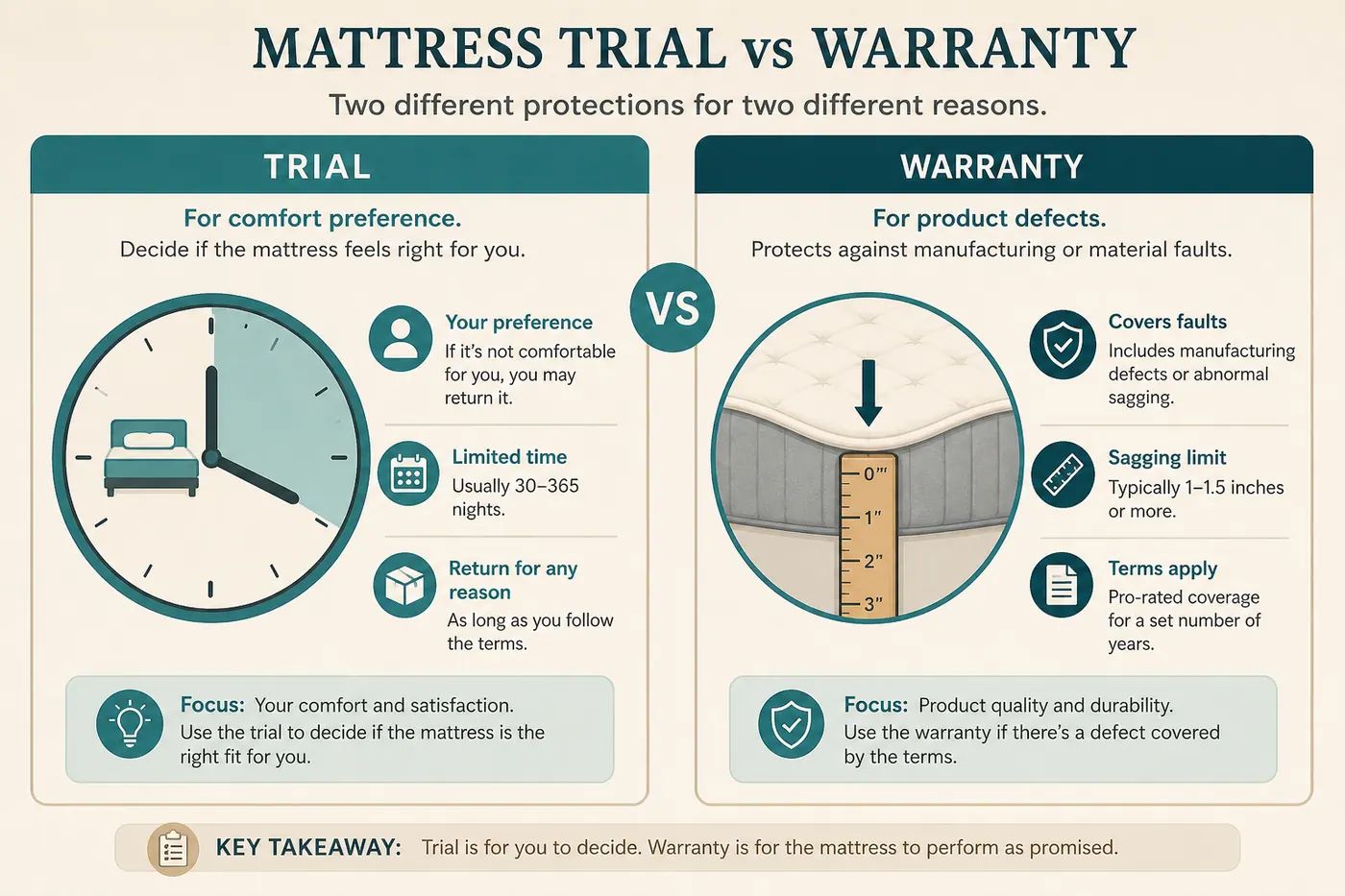
A mattress trial is a seller’s extra time to return or swap a bed after you sleep on it at home. It is a shop rule. It is not a legal quality grade. It is not a warranty. Night counts such as 14, 100 or 200 are marketing choices. They are not a British Standard.
If a seller offers no trial, that is allowed. Handmade and high-street makers sometimes offer an exchange instead, or nothing beyond the law. Always read that seller’s terms. BedGuide does not publish a league table of night counts.
How is a trial different from cooling-off or warranty?
Distance sales can have a cooling-off period under consumer law. That clock is about changing your mind on a purchase made away from a shop. A sleep trial is a later, extra promise about feel after nights in your own room. A warranty is about faults and sag. Three clocks. Three documents.
The legal clocks — 14-day distance cancel, 30-day short-term reject if goods do not conform, and shop change-of-mind — live on UK bed refund and return rights. This page stays on the shop trial.
| Promise | What it is for | Who writes it |
|---|---|---|
| Sleep trial | Comfort dislike after home use | The seller or brand |
| Cooling-off | Distance-sale change of mind | Consumer law, plus the seller’s process |
| Warranty | Faults and abnormal sag | The maker |
Do not wait until night 90 to discover the trial needed a protector from night one. Print or save the terms before the mattress arrives.
What conditions do trials usually set?
| Condition | Why it exists |
|---|---|
| Waterproof protector required | Keeps the mattress clean for resale or recycle |
| Minimum nights before return | Break-in time |
| One return per household | Stops people cycling beds |
| Collection fees or deductions | Pays for pickup and handling |
| Original base only | A saggy base can fake a “too soft” mattress |
Fees and deductions vary. BedGuide does not list prices. Ask the seller what you pay if you return, and whether collection is free.
How should I use a trial well?
- Check base compatibility first. A wide slat gap can make foam feel saggy. That is a setup fault, not a “wrong mattress.”
- Allow expansion if the mattress was rolled. Judging a compressed foam on night one is not a fair test.
- Rotate as the label says. One body dent in week two can be position, not a failed core.
- Sleep on it for the minimum nights. Comfort layers settle. Two cold nights are not a trial.
- Keep proof of purchase and proof you used a protector.
Judge after settling, not after one guest night on a spare bed. If you share, both people should sleep on it. A trial that only one partner used is a weak test.
What if the mattress still feels wrong after break-in?
Then the trial is doing its job. Contact the seller with the order number, the night count, and photos of the protector and the base. Ask whether they swap firmness or collect and refund. Those two paths are not the same.
If the issue is a broken spring or a deep dip, ask whether that is a warranty claim instead. Returning a faulty mattress on a trial may use up a “one return” rule you later need. See body impressions and sag.
Who should skip a sleep trial as a buying plan?
Skip treating a trial as a free hotel if the terms charge collection or refuse a soiled cover. Skip buying a mattress you already know is the wrong size and hoping the trial will save you. Size mistakes are often excluded. Skip this page if you need a solicitor for a refused return.
Related BedGuide entries
How it works
Frequently asked questions
How long should I trial a mattress before deciding?
Many shops want several weeks of nightly use. Comfort layers need time to settle. Returning after two nights often fails break-in rules. Follow the seller’s minimum sleep period.
Do all mattresses have a trial?
No. Trials are shop or brand rules. High-street and handmade makers may offer exchange, comfort guarantees, or none. Distance-selling cooling-off rules are separate from sleep trials.
Can I trial a mattress without a protector?
Often no. Many trials require a waterproof protector so the mattress can be collected clean. A missing protector can end the trial even if you slept the right number of nights.
Is a sleep trial the same as my cooling-off rights?
No. Distance-selling cooling-off is a consumer-law idea with its own clock. A sleep trial is a shop promise that can be longer, shorter, or absent. Read both. Do not assume one covers the other.