Pillow-Top vs Euro-Top vs Tight-Top Mattresses
Published 2026-08-03. Last updated 2026-09-08. Desk research by Kaiser Khan — we have not product-tested mattress surface types. This is not a shop review and not medical advice.
In short
Pillow-top, euro-top and tight-top describe how the top of a mattress is finished. A pillow-top has a distinct padded section; a euro-top fits more closely into the border. A tight-top has no separate raised pad. These labels do not establish firmness, support or turning instructions. Compare the complete model and its care label.
About 4 minutes to read
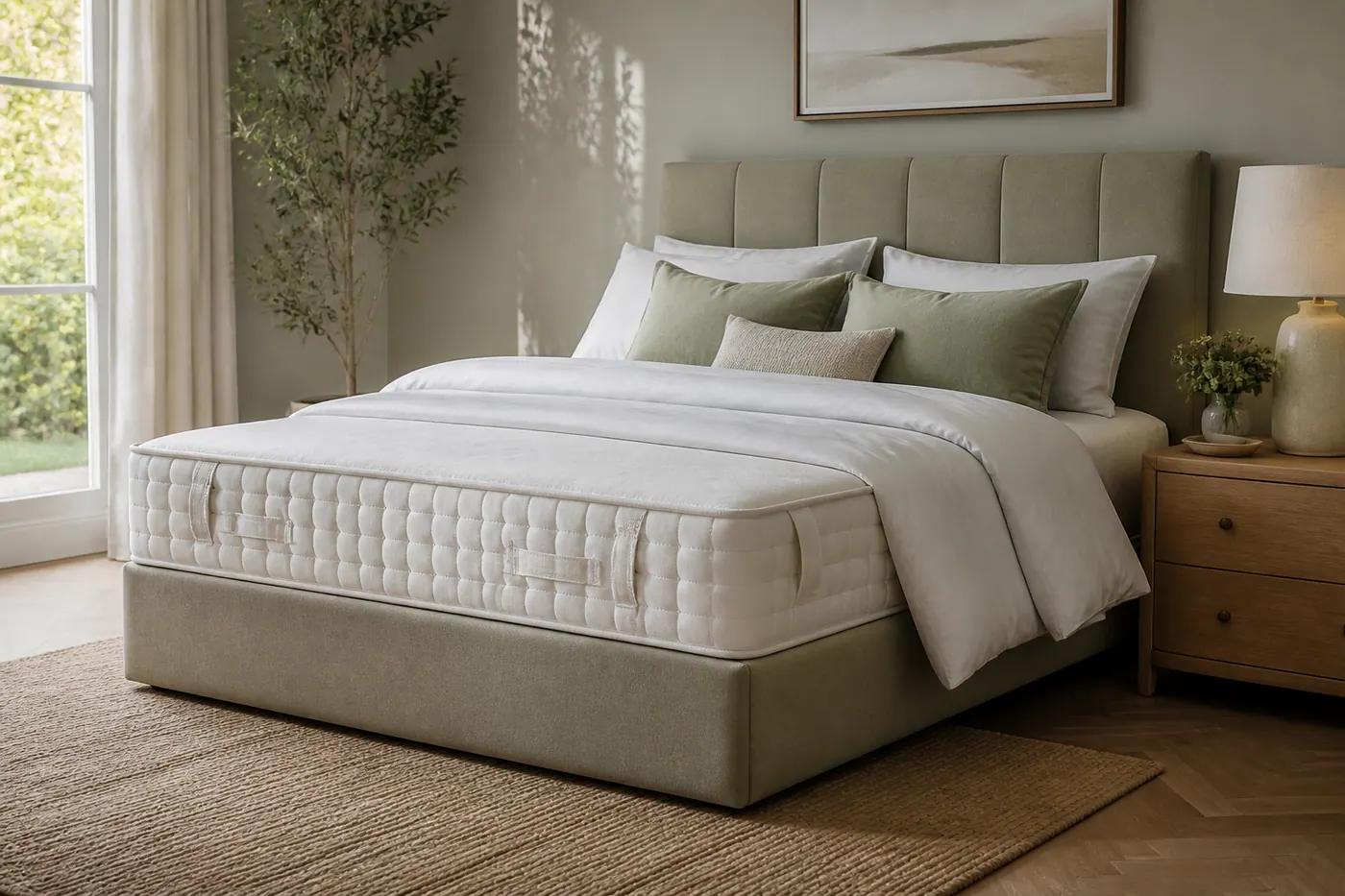
What materials go into this mattress?
Typical builds use quilt fibre, foam comfort pads, ticking. Exact stacks vary by model. Read the spec, not the shop slogan.
- quilt fibre
- foam comfort pads
- ticking
Pillow-top, euro-top and tight-top: the difference
The surface finish is only one part of a mattress. Underneath it may be pocket springs, connected springs or a foam core. The fillings and their arrangement affect the feel. Two mattresses with the same style of top can feel very different.
| Surface finish | How to recognise it | What to check |
|---|---|---|
| Pillow-top | A distinct cushioned section above the main border | What fills the pad, and is it permanently attached? |
| Euro-top | A padded top finished more closely within the outer border | The layer list and full mattress depth |
| Tight-top | No separate raised cushion section | The comfort fillings below the cover |
| No-turn or single-sided | One intended sleeping face | The maker’s rotation instructions |
No-turn describes care, so it is not a fourth surface style. A tight-top can be single-sided or double-sided. Never use the seam shape to decide whether a mattress can be flipped.
The manufacturer examples below show pillow-top and euro-top language in use. Naming can vary across ranges. Check the model’s construction drawing if the wording and photograph are unclear.
Is a pillow-top mattress always softer?
No. It has an added or distinct top section, but the materials and the structure below still matter. A tight-top can also contain substantial soft comfort layers. Compare the complete mattress in your usual sleeping position rather than choosing from the seam alone.
Check spring tension versus surface feel. A soft initial cushion does not tell you how the mattress supports you further down. Test edge support separately too; a flush euro-top edge is not proof of reinforced support.
Pillow-top versus a separate mattress topper
An attached pillow-top is normally part of the mattress construction. Do not assume it can be unzipped, washed or replaced separately. A removable outer cover does not necessarily make the fillings beneath it removable.
A separate topper sits above the mattress and has its own care instructions. It can change surface feel, but it does not repair damaged springs or a sagging base. Ask what is included when photographs show several layers.
Measure the full depth before buying sheets
Measure from the bottom of the mattress to the highest part of its sleeping surface, without pressing the cushioning down. Include a separate topper if you will use one. Then compare that measurement with the fitted-sheet maker’s stated depth range.
Do not assume a sheet labelled “deep” has a standard pocket size. Also check the combined height of base and mattress. Extra depth changes how much headboard remains visible and how high the bed feels when sitting down.
See mattress depth and fitted sheets. For a bunk or high sleeper, the bed’s maximum mattress-depth mark takes priority over appearance or comfort-layer labels.
Turning, cleaning and changes in the surface
Follow the exact care label. Rotate means swapping head and foot while keeping the same sleeping face up. Turn means flipping the mattress over. Only turn it when the maker allows both faces to be used.
A care schedule for another range may be wrong for yours. Do not cut an attached pad, soak the fillings or assume a zipped cover is washable. Record any new dip or uneven area and ask the seller how to measure it. Use body impressions and sag to prepare the information for that discussion.
Before ordering, record the core type, top fillings, complete depth, base rules and care instructions. Those facts are more useful than treating pillow-top as a quality grade.
Frequently asked questions
Is a pillow-top mattress the same as a mattress topper?
No. An attached pillow-top is part of the mattress construction. A separate topper is an additional item with its own care instructions. Check whether any pad or cover is actually removable.
Can you flip a pillow-top or euro-top mattress?
Only if the exact model’s instructions allow both faces to be used. Many models have one sleeping face. A pillow-top or euro-top label alone is not a reliable turning instruction.
Does a pillow-top mattress need deep fitted sheets?
Measure the full mattress depth, including any separate topper, and compare it with the sheet maker’s stated pocket-depth range. The phrase deep fitted sheet is not enough to confirm a fit.
Where do these facts come from?
BedGuide is desk research. The numbers and rules on this page were checked against the official or primary sources below. We name the check date. We do not invent a figure when a source is missing.
- Saatva: euro pillow top and standard pillow top — Manufacturer explanation of the seam and edge distinction. US construction terminology is used here, not US size or care rules. Checked 2026-09-08.
- Sealy UK: Buckingham mattress — UK manufacturer example of a pillow-top surface above a spring system. Checked 2026-09-08.
- Sealy UK: plush Posturepedic ranges — UK manufacturer examples using euro-top terminology. These examples are not comparative performance tests. Checked 2026-09-08.