bedding comparison
Down / feather vs Hollowfibre / microfibre
Evergreen URL: /compare/down-vs-hollowfibre
In short
Down clusters trap air efficiently and are rated by fill power; hollowfibre and microfibre use synthetic fibre geometry for loft and are often easier to wash. TOG still measures the finished duvet’s insulation. Choose by loft preference, care method and allergy considerations — not by which fill sounds more premium.
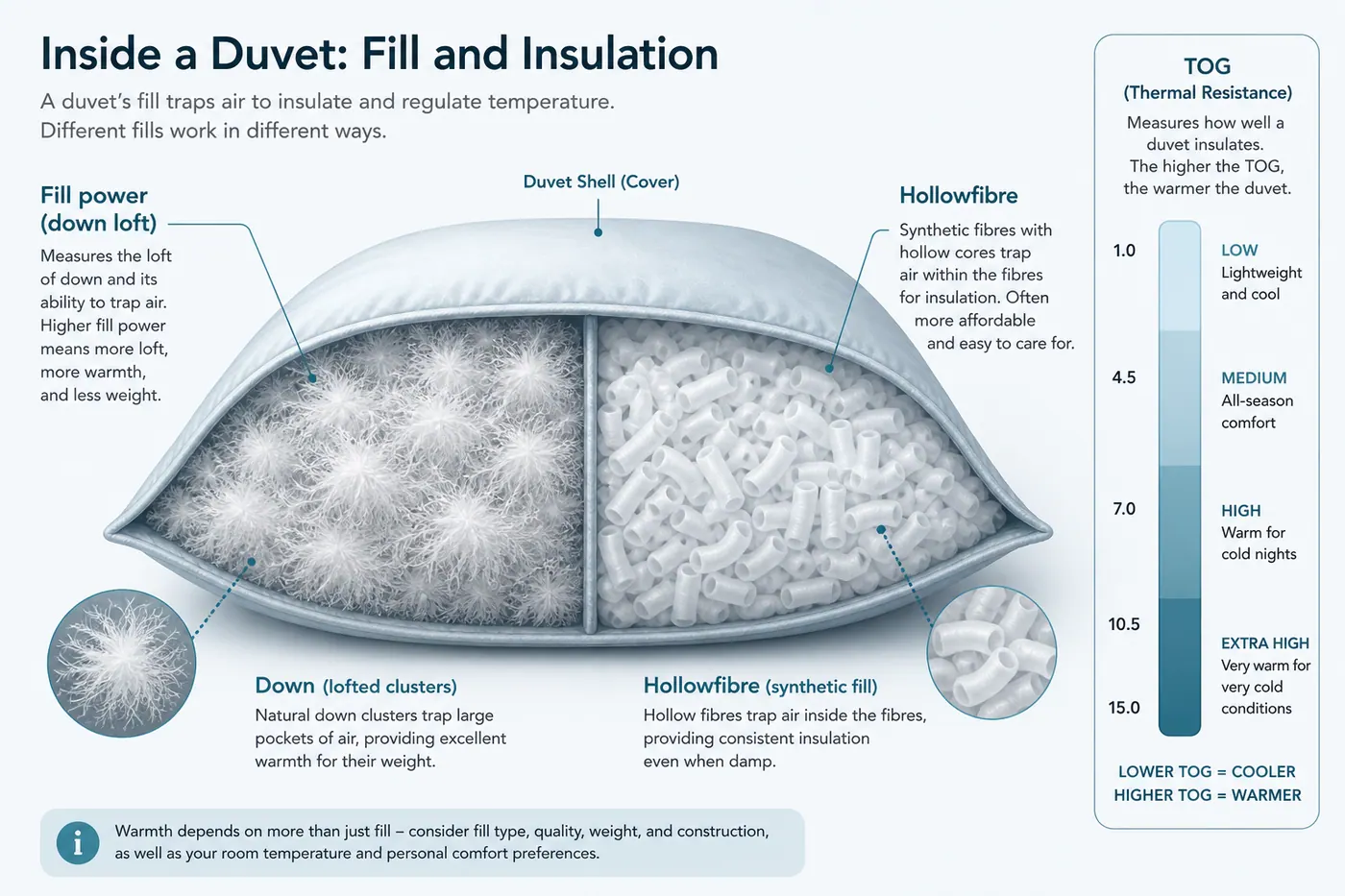
Fill type and TOG answer different questions. See the duvet guide for seasonal TOG bands and fill-power definition.
What is the difference between Down / feather and Hollowfibre / microfibre?
Down clusters trap air efficiently and are rated by fill power; hollowfibre and microfibre use synthetic fibre geometry for loft and are often easier to wash. TOG still measures the finished duvet’s insulation. Choose by loft preference, care method and allergy considerations — not by which fill sounds more premium.
| Criterion | Down / feather | Hollowfibre / microfibre |
|---|---|---|
| Loft metric | Fill power (down) | Fibre geometry / fill weight (no fill power) |
| Warmth rating | Finished TOG of the duvet | Finished TOG of the duvet |
| Compressibility | Usually excellent with high fill power | Good; recovery varies by fibre |
| Care tendency | Specialist wash / professional clean often advised | Often home-washable per label |
Who is Down / feather for — and who should skip it?
- You want maximum loft per mass from down clusters
- You accept specialist care for natural fill
Who is Hollowfibre / microfibre for — and who should skip it?
- You want simpler washing routines
- You prefer synthetic fills for allergy or budget framing
Frequently asked questions
Is hollowfibre warmer than down?
Not inherently. Compare TOG of the finished duvets. A high-TOG hollowfibre can out-insulate a low-TOG down duvet.