Replace a Mattress Every 7–8 Years? Explained
By Kaiser Khan, Editor Updated First published
Desk research from official sources. Not a product test or medical advice. How we check facts.
Saved on this browser only. How saving works
In short
The advice to replace a mattress every seven to eight years comes from the UK bed industry. The National Bed Federation and its Sleep Council first said every ten years in 1995, then shortened it. It is a rule of thumb, not a law. Your mattress's condition matters more than its age.
- Current UK bed industry advice for replacing a mattress
- 7–8 years
- The Sleep Council's first advice, in 1995
- 10 years
- Use a mattress gets in 7–8 years
- About 20,000 hours
- Average UK mattress replacement cycle in 2019
- 6.9 years
- Sets a fixed age for replacing a mattress
- No law
From the National Bed Federation and The Sleep Council.
At the time, many people kept a bed for about 20 years, the NBF says.
Eight hours a night for seven years is about 20,400 hours.
NBF consumer research, down from 7.9 years in 2016.
Support, comfort and hygiene matter more than the date.
About 4 minutes to read
How it works
Should you replace your mattress every 7–8 years?
Not automatically. Seven to eight years is a rule of thumb. It reminds you to check your mattress. It is not a use-by date.
Replace a mattress when it stops doing its job. That means it sags, has lumps, creaks, or no longer feels even across the surface. A mattress in good condition can last longer. A cheap or heavily used one may wear out sooner.
Key figures
| Figure | What it means | Year | Source |
|---|---|---|---|
| Every 10 years | The Sleep Council’s first advice | 1995 | NBF, via The Sleep Charity |
| About 20 years | How long people kept beds before that, the NBF says | Before 1995 | NBF, via The Sleep Charity |
| Every 7–8 years | Today’s industry advice | Current | NBF and The Sleep Council |
| About 20,000 hours | Use over 7–8 years | — | NBF, via Furniture News |
| 6.9 years | Average actual replacement cycle | 2019 | NBF consumer research |
| 41.56% | Adults who kept their last mattress 6 years or less | 2022 | Censuswide survey for NLWA |
Where does the number come from?
The advice comes from the UK bed industry. The National Bed Federation (NBF) is the trade body for UK bed makers. In 1995 it set up The Sleep Council to give advice to the public.
The Sleep Council’s first message was to replace beds every ten years. The NBF says many people then kept a bed for about 20 years. Later, the advice shortened to every seven to eight years.
The usual reason given is wear. Over seven to eight years, a mattress is used for about 20,000 hours. That is roughly eight hours a night, every night.
What the number does not mean
- It is not a law. No UK rule says a mattress must be replaced at a set age.
- It is not a test result. We did not find a published study that sets eight years as the limit.
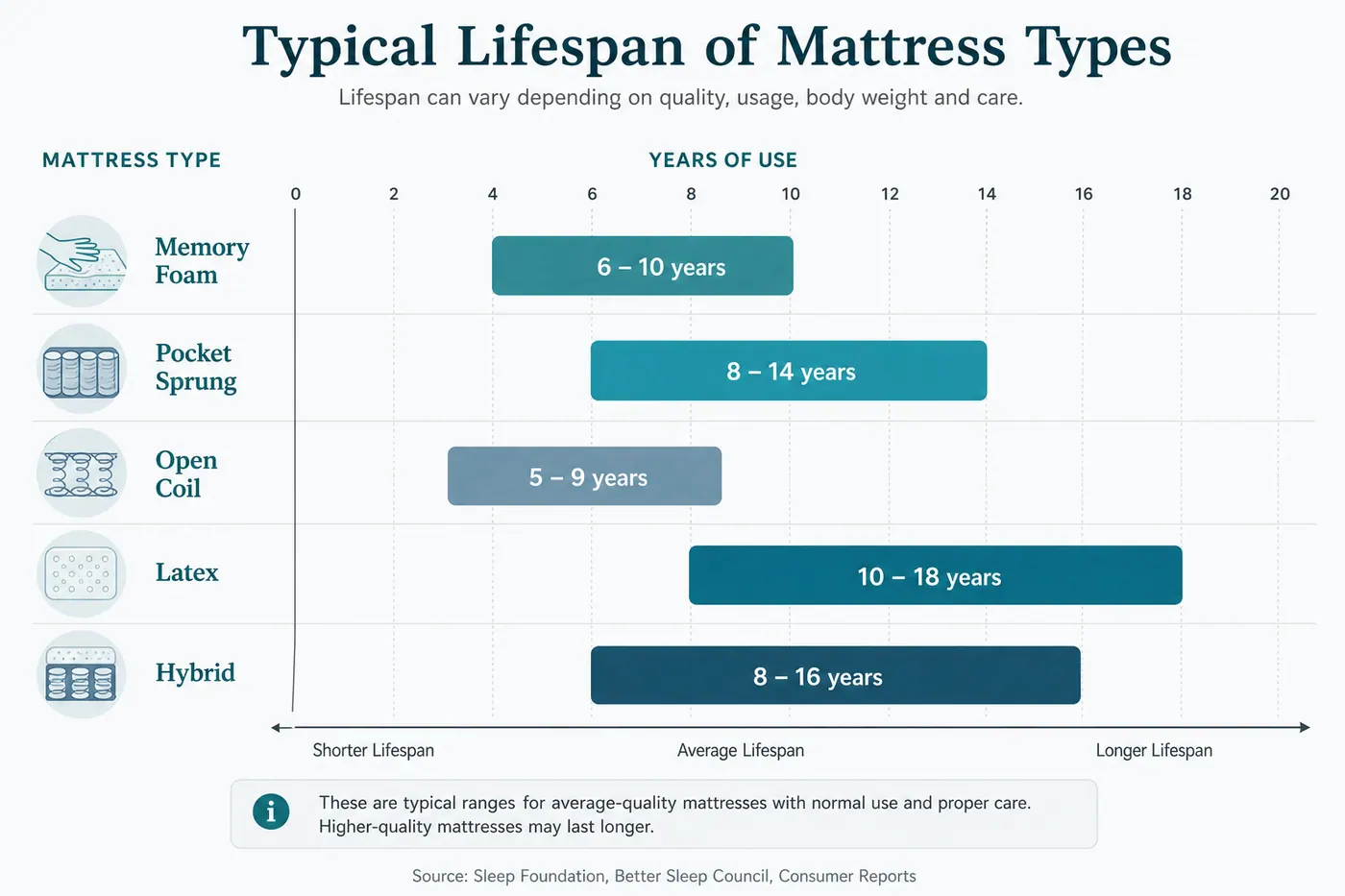
- It is not the same for every mattress. Foam, springs and latex wear at different rates. How much the mattress is used matters too.
- It is not neutral. The advice comes from a trade body whose members sell beds. That does not make it wrong, but it is worth knowing.
Is this the latest figure?
Yes. Seven to eight years is still the industry’s advice. What people actually do has changed, though.
NBF research found the average replacement cycle fell from 7.9 years in 2016 to 6.9 years in 2019. But the NBF’s October 2025 report says mattress disposals were 27% lower in 2023 than in 2020. It suggests people may now be keeping mattresses longer, possibly because of money pressures.
How do you know when to replace your mattress?
Check the mattress, not the calendar:
- Can you see a dip or body impression that does not recover?
- Do you feel springs, lumps or hollows?
- Does it creak or feel uneven?
- Has a stain, spill or damage made it unhygienic?
- Has the base underneath been checked? A worn base can make a mattress feel worse.
Read the full checklist in when to replace a mattress. See typical ranges in mattress lifespan by material. To make a mattress last, see turning vs rotating. When the time does come, our guide to disposing of an old mattress explains your options.
Frequently asked questions
Should I replace my mattress every 7 years?
Seven to eight years is a rule of thumb from the UK bed industry, not a law. Replace it sooner if it sags, has lumps or no longer feels even. A well-made mattress in good condition can last longer.
Where does the 7–8 year mattress rule come from?
From the National Bed Federation and The Sleep Council, which the federation set up in 1995. Their first message was every ten years, when many people kept beds for about 20 years. It later became seven to eight.
Is the 7–8 year advice based on research?
The industry links it to wear: about 20,000 hours of use over seven to eight years. We did not find a published study that sets eight years as a limit. Treat it as a reminder to check your mattress.
How long do mattresses usually last?
It depends on the materials and how the mattress is used. Typical ranges are about 6–8 years for many foams, 7–10 for pocket sprung and hybrid, and 8–12 for latex. These are ranges, not promises.
Does the bed industry gain from shorter replacement advice?
It can. The advice comes from a trade body whose members sell beds, so it is fair to ask why. That does not make it wrong. Your mattress's condition is a better guide than the calendar.
How often do people in the UK actually replace mattresses?
NBF consumer research found an average of 6.9 years in 2019, down from 7.9 years in 2016. Its 2025 report suggests people may now keep mattresses longer, as disposals fell 27% between 2020 and 2023.
Where do these facts come from?
BedGuide is desk research. The numbers and rules on this page were checked against the official or primary sources below. We name the check date. We do not invent a figure when a source is missing.
- The Sleep Charity — guest blog from the National Bed Federation, 2021 — NBF executive director says the NBF founded The Sleep Council in 1995 to advise replacing beds every ten years, against a 20-year norm, and that seven to eight years is advised today. Checked 2026-10-21.
- Furniture News — mattress replacement cycle shortening, April 2019 — Reports NBF research: mean replacement cycle of 6.9 years, down from 7.9 in 2016, and the advice to replace every seven to eight years, about 20,000 hours of use. Checked 2026-10-21.
- National Bed Federation — fifth end-of-life mattress report, October 2025 — Reports mattress disposals 27% lower in 2023 than in 2020, which it links to slower replacement and longer use. Checked 2026-10-21.
- North London Waste Authority — early mattress replacement, February 2022 — Censuswide survey of 2,000 UK adults: 41.56% kept their last mattress for six years or less. NLWA estimates 2.9 million mattresses a year end early. Checked 2026-10-21.